Tuesday, October 24, 2017

Think Critically
1. a; 651.3
b; 486.3
c; 434.2
d; 410.3 all in nano-meters

2. Yes, most of them are the same, but around .1 off. My rounding may have been different from the universal type of rounding.

3.  a; 3.05(10^-19)
b; 4.09(10^-19)
c; 4.58(10^-19)
d' 4.84(10^-19)

4. wavelength 2.28(10^-6)
Energy= 1.99(10^-25)

In this activity, I used the Rydberg constant to find the wavelengths or certain electrons. I put the work to my answers on the bottom. The Rydberg equation is like Planck's constant to find the wavelength of spectral lines. This describes the relation between wavelengths in spectral lines and alkali metals. The Balmer series represents colors, for exaple, 3-2 is red, 4-2 is aqua, 5-2 is blue, and 6-2 is violet, everything else is an ultraviolet color.

Wednesday, October 18, 2017

 1. Copper
2. Iron
3. Sodium
4. Potassium
5. Strontium
6. Calcium


certain elements like lithium or sodium are harder to control their electrons because there are so many electrons on the outside. 
elements like fluorine or bromine are easier to maintain the electrons because there are less on the outside. 
The electrons on the outside want to follow the Octet Rule and gain 8 electrons like Neon or Helium. That’s why certain elements will give up elements, and others will take elements.


The different colors of the flames are a result of energy. Their atomic emission spectra affect the frequencies of the light, the flame color depends on the chemical additives. Certain flames are a combination of colors because the element has not been fulled burned off yet. As the electrons return to lower levels, they emit colors characterized by a color spectrum


Analysis Questions
1. Suggest a reason why each compound produced a flame of a different color, even though they each contain chlorine.
Even though they all have chlorine, the chemical makeup of each element is different. For example, certain elements like iron will have more electrons than others. 
After the flame, the electrons would drop a level. The color depends on the difference in the two energy levels
2. Explain how an element's flame test might be related to its atomic emission spectrum. 
The color of the element is the combination of all the colors of light produced by the element.  The colros are a result of the visible spectrum. 
The color results from the return to lower levels after the flame, causing the amount of electrons which causes the different color of flame. 
3. Infer the identity of the unknown crystals. Explain your reasoning. 
The table on the left shows what we thought each element was. We decided each of these by the color of the flame, and we decided some were the same element because of the color of the flame was the same, and the material that was burned looked, smelled, and weighed the exact same. 


Saturday, May 13, 2017


Here are all the pictures we took on the Eco of Bellarmine lab. 
Producer- Tree, or plants
Primary Consumer- bug
Secondary Consumer- Chicken
Tertiary Consumer- Humans (Nolan)
Decomposer- Picture of Orange with worms
Herbivore- myself because I am vegan haha
Carnivore- We found a cat in the garden, but we couldn't get a good picture. 
Omnivore- Human (Jordan)
Threatened Species- Bees
Endangered Species-Bees
Non-Native Species- Cactus
Pollution Source- Car


Questions
1. Ecology is more about the organisms and their interaction with their environment, while environmental science is more about the environment and how it reacts to the organisms living around it. The animals like chickens for example adapted to living in a big group and the decomposers reacted to living around the orange tree for food. 

2. There are no real specific ecosystems on Bellarmine campus, however, the garden was a big environment for populations and communities.  The weather affected the plants like the cacti, and the animals changed the overall context of the community. 

3. The sun produces plants, such as trees or grass. The bugs live on the tree or eat the plants. Then, the chicken will eat the bug, and then humans eat the chicken. This transfer of energy can be seen quite clearly. 

4. The only real endangered of threatened species on campus we found were bees. As of since June of this year, the Bumblebee has been placed on the endangered species list. As more and more Co2 is released into the oxygen, the bees die at an alarming rate. Bees are extremely important to all life on earth because of their pollination. 

5. Anything that is harmful to the environment. Pollution can occur anywhere. Things like a car because of the gas, things like machines produced CO2, and even things as simple as eat meat can all indirectly cause pollution. Pollution is everywhere, and there are a lot of things to stop it, but a lot of people either do not care about global warming or don't believe in it. The reason I decided to go vegan about 12 months ago was because I knew it would not only help myself but everything around me. 

Friday, May 5, 2017

I learned that when environmental factors like light or temperature change, the heart rate drastically changes. For example, when we started with room temperature their heart rate went up, but when we raised the temperature, their heart rate got even faster. Eventually, when we added ice to the cup, their heart rate went down a lot. The average was almost twice as low to when it was at room temperature. We then came up with experimenting with light, and we predicted that their heart rate would rise due to higher intensity of light. Overall, we learned that their heart rate changes a lot due to temperature and that their heart rate increases when the temperature rises.

Thursday, April 27, 2017

I learned in the fish pong genetics virtual lab that very slight changes in things like migration rate, or mortality rate can completely change the population and the next generations. When I made the migration rate plus one, it changed everything, the graph, the population, and mortality rate. In any community, very slight changes will change the whole community forever. I tested things such as putting the mortality rate really low, and migration rate high and the rate of generations almost tripled. Things like changing the rate of fitness can also change the whole community. Overall, I learned how fragile a community really is because very small changes will change it forever.

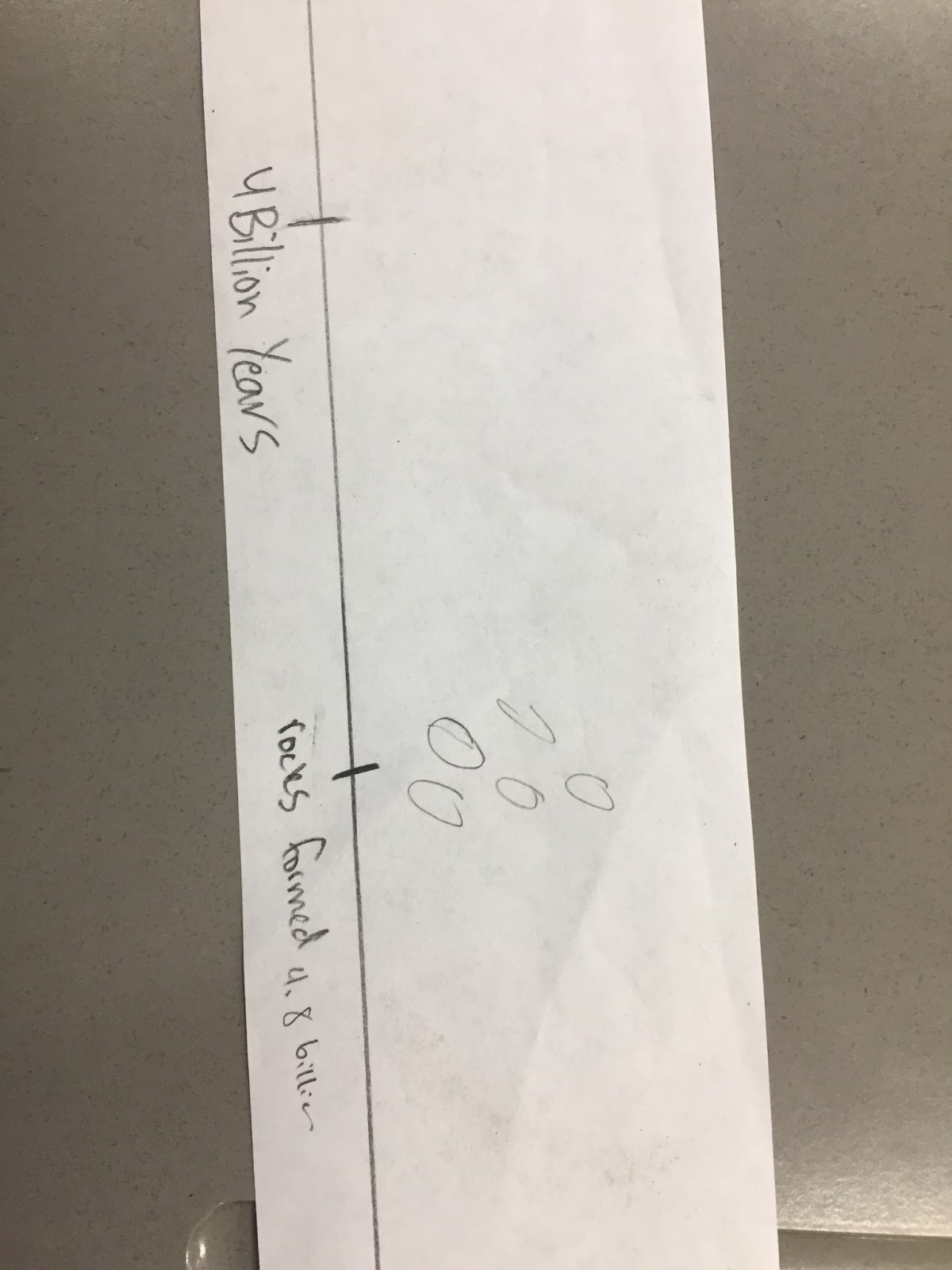
Saturday, March 25, 2017

In class, my group and I created a geological timeline to show when big events happened such as fossils being found, humans living, dinosaurs being extinct, etc. I realized that humans have barely been on this planet, in comparison to things such as plants and animals first appearing. For the first around 2 billion years on Earth, not much happened. Lots of important events relating to humans, happened around the Cenozoic, events to dinosaurs happened around the Mesozoic era, and first forming animals and plants important happened around the Paleozoic era. As shown in the timeline, evolution must have happened because over the billions of years Earth has been around plants and animals have clearly changed over time, which supports the theory of evolution. In the early years, organisms were first forming and over time changed and adapted.