Saturday, March 17, 2018


In this experiment, we tested the pressure caused by mentos and diet coke. First, we took an empty bottle of coke and cut in half, to create a base or launch pad. Then we took a paper clip and put 5 Mentos onto the paper clip, and put that onto a cork. Then we went outside and put the cork with the mentos on top of the coke bottle. then we flipped over the coke and it created a rocket.
Why?
Due to gas laws, and the pressure we created, it created a huge explosion, making it look like a rocket. This is a process called nucleation, where a large amount of carbon dioxide in the diet coke is attracted to the Mentos, causing an immense amount of pressure, thus causing it to explode. Because we put a cork on top of the bottle, the pressure increased greatly. Because the also flipped it upside down and had a base, it was able to fly higher. The Mentos sank because they are fairly dense, and then quickly created bubbles. Low surface tension also helped the bubbles to grow faster. Diet coke works better than normal Coke because it is lower than in sugary water, creating a better rocket.
Gas Laws:
Due to Henry's Law, P=Kc. the p=partial pressure of the gas, K is the constant, and C is the molar concentration of the solute. This is why sodas fizz when you open them. The bubbles form in liquids due to the dissolved gas, and it is easier to form in soda than water. A nucleation site is always needed to form bubbles.
What went wrong?
I think the main reason this went wrong was the weight of the 2-liter bottle of coke. This was a lot of weight for only 5 mentos. We should have either have smaller bottles of coke, or more mentos in the bottle. We could have had two paper clips of mentos and a smaller bottle of coke and it would have flown much higher. Both of these would have increased the pressure, and decreased the weight, thus making it fly higher. Other factors such as temperature, angle, and inproper cutting could have also effected this procedure.
Thursday, January 25, 2018
Limiting Reactant Lab
Analysis questions
1. What are the limited and excess reactants for each flask? How did you determine this?
The limited reagent was the baking soda for the flask with 1 and 2.5 grams of baking soda. For the flask with 4 grams of baking soda, and our own personal experiment, the vinegar was the limited reagent. Below is my work for finding what each limited reagent is. I found that for the flask with 1 and 2.5 grams of baking soda, this was less than the controlled variable, meaning that the baking soda was limited.


2. How is the amount of product in a reaction affected by an insufficient quantity of any of the reactants?
If a reaction has a limited quantity, it will not be able to completely finish it's reaction. When there is a limiting reaction, the end result will be heavily affected due to the limiting reactant. They results will not be accurate or precise due to the lack of true experimental values.
3. Which balloon was the largest? Explain.
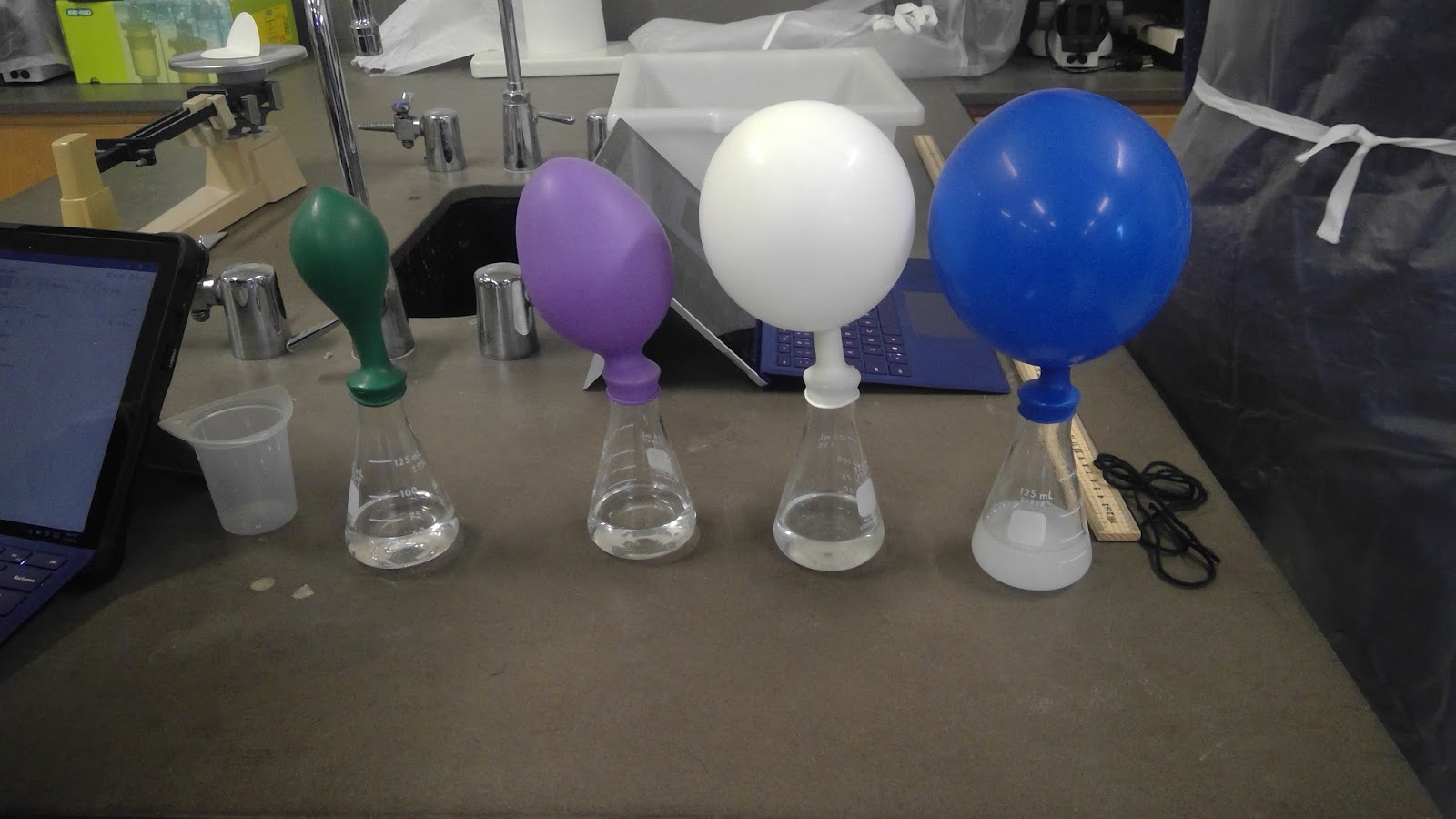
The largest balloon was our personal experiment. We filled a balloon with the rest of the baking soda, which was around 10.75 grams of baking soda, with a radius of 6.37. This was the biggest, but the biggest balloon from the actual experiment was the balloon with 4 grams of baking soda, with a radius of 5.57.
4. Which balloon was the smallest? Explain.
The smallest balloon was the green balloon, the one with the least amount of baking soda. This one had 1 gram of baking soda, and reacted with the least amount of time. This had the least amount of baking soda, which meant is had the least amount of carbon dioxide in the balloon. It's radius was 2.47.
5. Rust is produced when iron reacts with oxygen. How many grams of Fe2O3 are produced when 12.0 g of iron rusts?
 4Fe(s) + 3O2(g) → 2Fe2O3(s)
It forms a total of 17.2 grams. My work is pictured above.
6. What real-life applications can this concept of limiting and excess reagents be applied to?
Limiting and excess reactants can be applied to real life because when certain items are limited, it affects the goal you are trying to attempt. For example, if your energy is limited, then the rest of your day will be affected due to the limited reactant.


1. What are the limited and excess reactants for each flask? How did you determine this?
The limited reagent was the baking soda for the flask with 1 and 2.5 grams of baking soda. For the flask with 4 grams of baking soda, and our own personal experiment, the vinegar was the limited reagent. Below is my work for finding what each limited reagent is. I found that for the flask with 1 and 2.5 grams of baking soda, this was less than the controlled variable, meaning that the baking soda was limited.


2. How is the amount of product in a reaction affected by an insufficient quantity of any of the reactants?
If a reaction has a limited quantity, it will not be able to completely finish it's reaction. When there is a limiting reaction, the end result will be heavily affected due to the limiting reactant. They results will not be accurate or precise due to the lack of true experimental values.
3. Which balloon was the largest? Explain.
The largest balloon was our personal experiment. We filled a balloon with the rest of the baking soda, which was around 10.75 grams of baking soda, with a radius of 6.37. This was the biggest, but the biggest balloon from the actual experiment was the balloon with 4 grams of baking soda, with a radius of 5.57.
4. Which balloon was the smallest? Explain.
The smallest balloon was the green balloon, the one with the least amount of baking soda. This one had 1 gram of baking soda, and reacted with the least amount of time. This had the least amount of baking soda, which meant is had the least amount of carbon dioxide in the balloon. It's radius was 2.47.
5. Rust is produced when iron reacts with oxygen. How many grams of Fe2O3 are produced when 12.0 g of iron rusts?

It forms a total of 17.2 grams. My work is pictured above.
6. What real-life applications can this concept of limiting and excess reagents be applied to?
Limiting and excess reactants can be applied to real life because when certain items are limited, it affects the goal you are trying to attempt. For example, if your energy is limited, then the rest of your day will be affected due to the limited reactant.


Saturday, December 9, 2017
electrolytes in my fridge


- Orange Juice
- Spinach
- Coconut Water
- Kale
- Fruits
- Pickles
- Olives
- Milk
- Cheese
- Yogurt
- Eggs
Thursday, November 30, 2017
thinking about electrolytes and conductivity
In this lab, first we got all of our materials, like the pennies, salt, water, vinegar, matte paper, sandpaper, and LED lights. Then, we started rubbing the copper of the pennies for 4/5 of the pennies on the sandpaper, and then we soaked the matte paper in a solution with vinegar, salt and water. After this, then we put the matte paper, and the pennies together with the LED light. We tried using other LED lights, with different colors, and tried re-doing the solution, but none of them worked.
The reason all this happens because it's like a battery. Because of the positive and negative sides, it creates a battery-like product. Unfortunately, ours didn't work. When metals are connected to electrodes, and are connected to a wire, the electrons move from one penny to the other, creating an electric current. The reason our didn't work could have possibly been because we used a 1982 penny, which would have not been a post-1982 penny. Also, our solution could've been wrong because we could've used too much or little water, salt or vinegar. The mattepaper soaked in the electrolyte-like product due to the acids, created an electrolyte between the two pennies. Alessandro Volta, who created the first battery, which is why this is called a voltaic pile.
Here are out pictures of the lab. First, here's a picture of the pennies on the sandpaper, then there's a picture of the final penny battery. As you can see in the bottom two pictures, the LED light did not turn on.


Friday, November 10, 2017

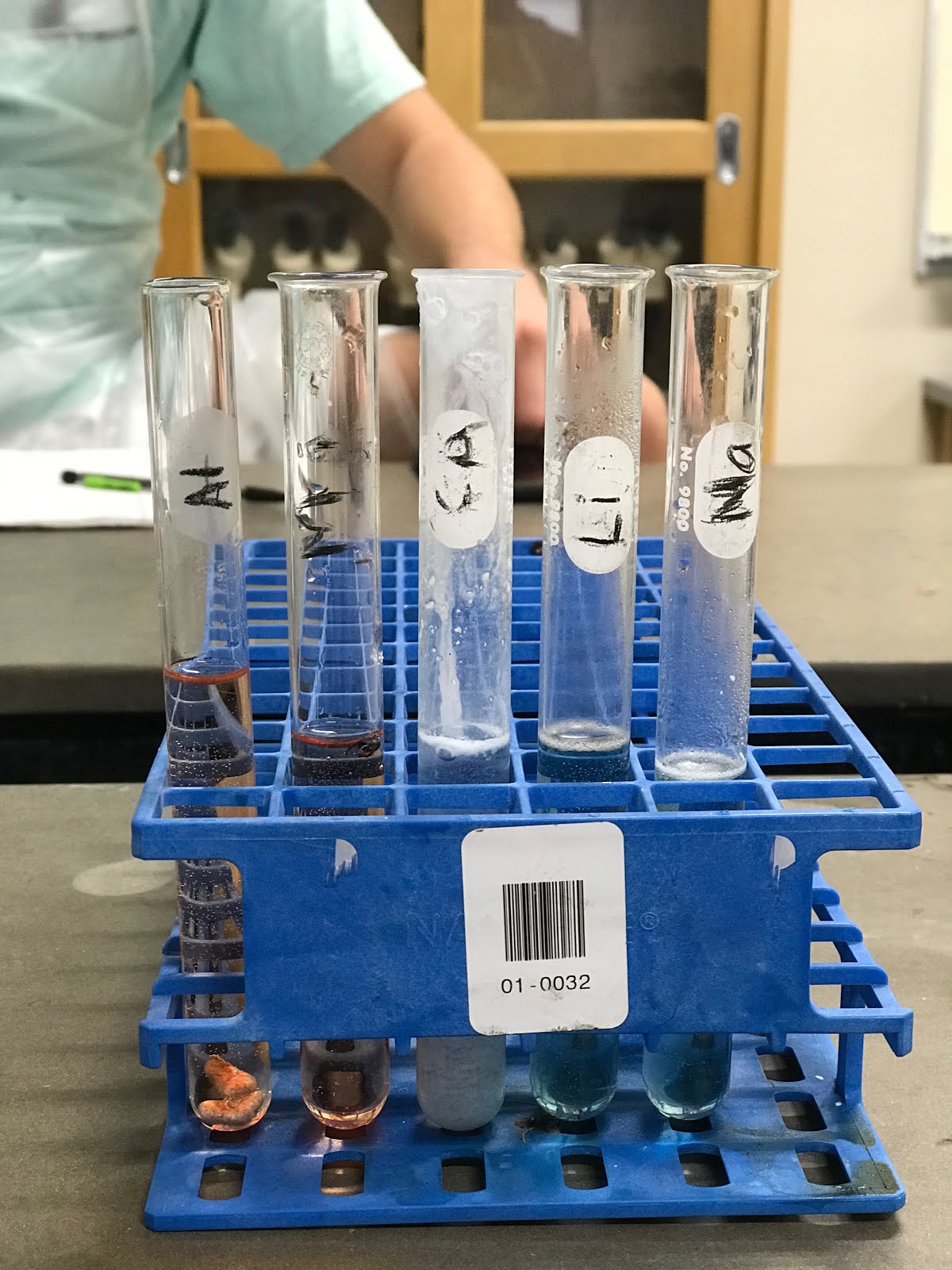
I learned this happens depending on its number of valence electrons and orbitals. Sodium turns immediately because it only has to get rid of one valence electron, and it has a 3S orbital, rather than a 2S orbital like Lithium has. I assume the lower you go on the alkali metals, the faster the reaction will be. Elements like Lithium will be slower than Sodium, yet still faster than any electron with more than one valence electron. Calcium and Magnesium take longer to react because they have two valence electrons, and it's much harder to get rid of two electrons than one. For elements with two valence electrons, it must get rid of two electrons in the outermost shell, which is much harder than to get rid of one valence electron in the outermost shell. Aluminum takes the longest because it has the most valence electrons out of all the 5 elements. The more valence electrons the element has, the longer it takes to react. Aluminum has 3 valence electrons, more than any other element we tested. Also, magnesium and aluminum are on the same 3rd period, meaning that aluminum will take a similar amount of time to react as magnesium.
Here are some of the pictures we took. I tried to put them in order of before and after, but the pictures were too big and would not let me place them.




Tuesday, November 7, 2017

1. Finger numbers
2. Facial Expression
3. Arm Position
4. Size vertical
5. Size horizontal
6. Pattern
7. Number of curls
8. Arms number
The number of fingers, arms and curls increase my group number. The facial expression continually gets happier as it moves down until the noble gases. The arm position, similar to number of fingers continually moves down. The size gets smaller when you go down in periods, and the size gets bigger when you go across by group, and the pattern stays the same within the group.
Subscribe to:
Posts (Atom)